Where to Start Reading the Bible: A Beginner's Plan
September 11, 2026 · 6 min read
The honest answer to "where should I start reading the Bible?" is probably not Genesis 1, and definitely not Leviticus.
That surprises people. The Bible is a book, books start at the beginning, so you open to page one. Then you hit the genealogies in Genesis 5, the tabernacle measurements in Exodus, and the sacrificial laws in Leviticus, and you quietly stop somewhere in February. It happens to almost everyone who tries the front-to-back approach without a plan.
The Bible is a library of 66 books written over about 1,500 years, in three languages, in a dozen different genres. Some of those books are easy to read on your first day. Others are hard even for people who have read them ten times. A beginner's plan just puts the easy ones first.
The short version
If you want one answer: start with the Gospel of John, five minutes a day, and follow a plan that tells you exactly what to read tomorrow.
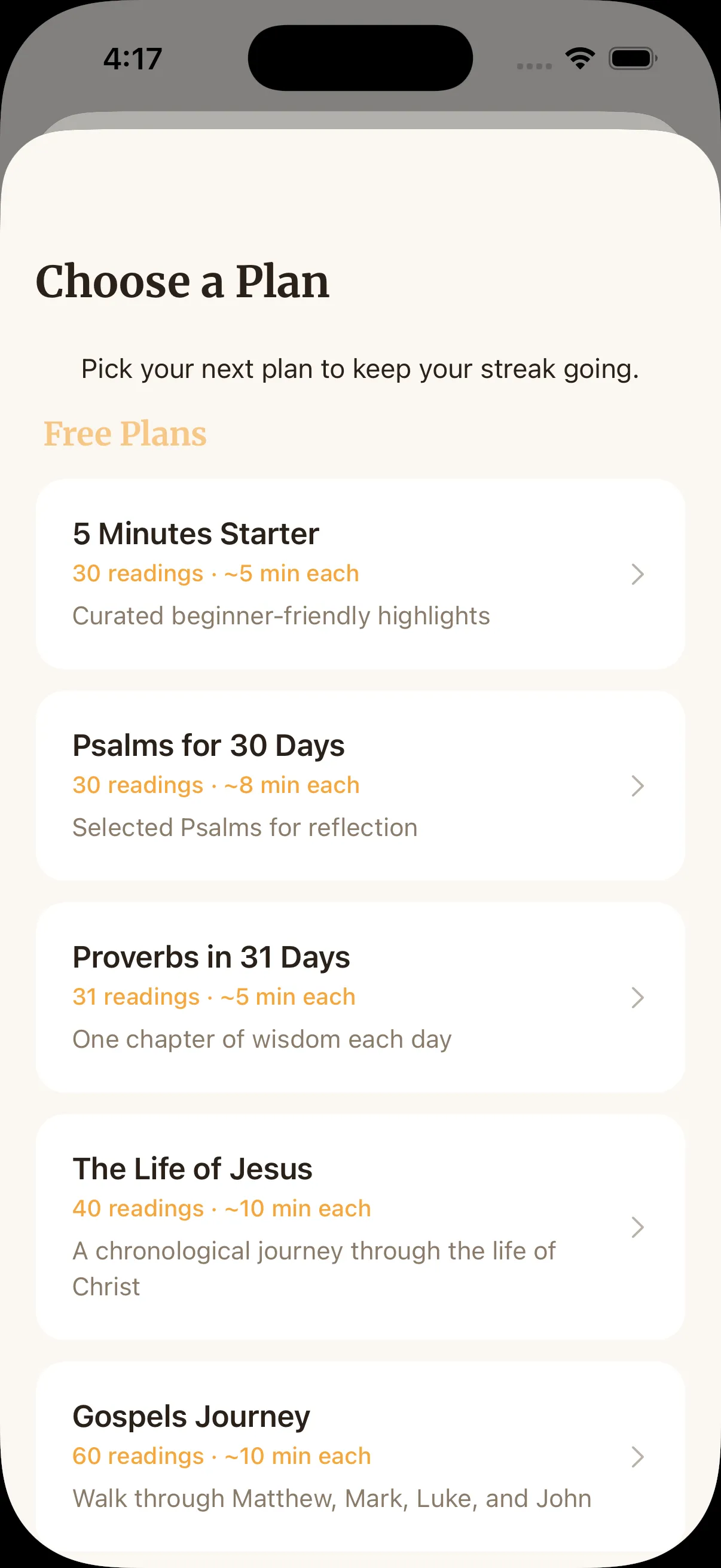
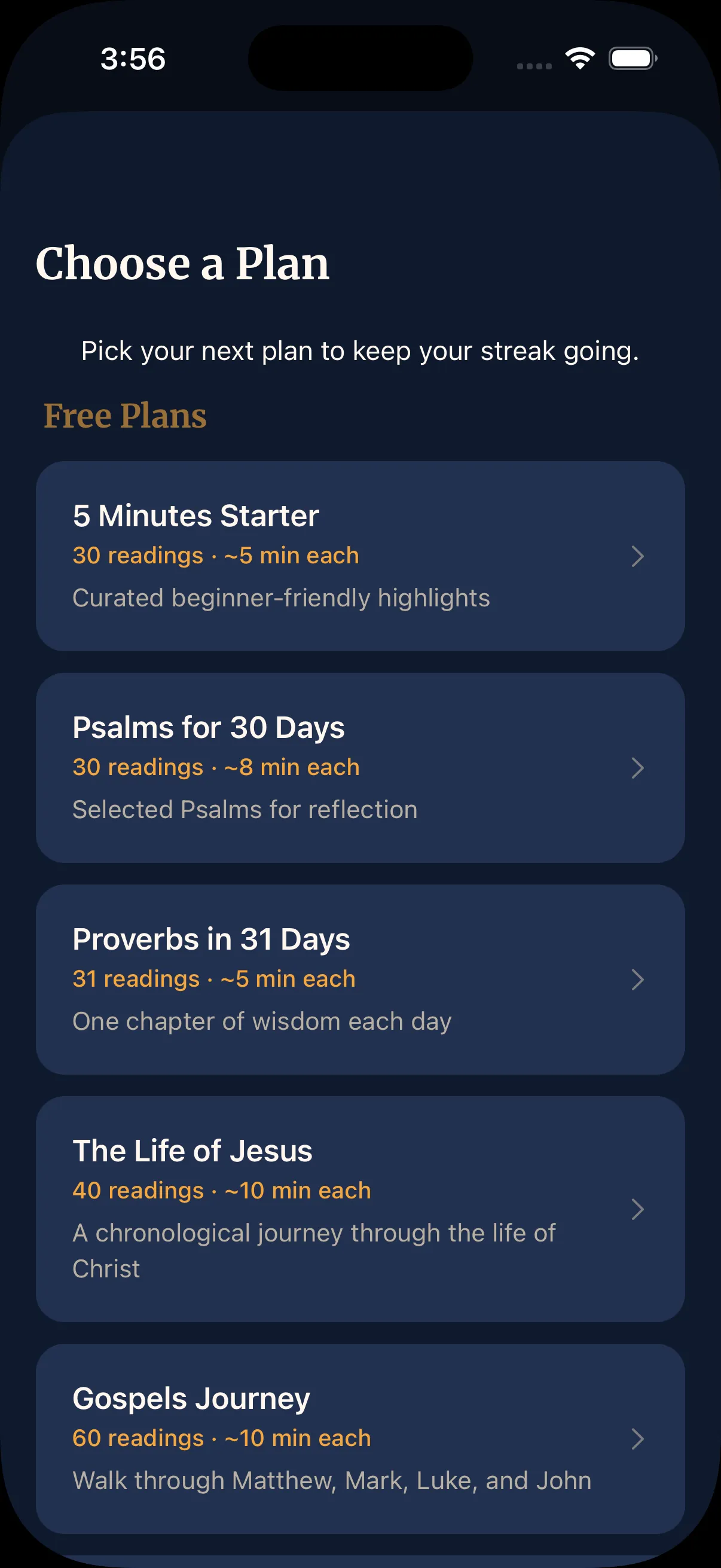
If you want a plan that already does this, the 5 Minutes Starter is a free 30-day plan built for people who have never read the Bible before. It comes with a printable PDF you can stick on the fridge. The rest of this post explains why it is arranged the way it is, and what to do after day 30.
Why a plan matters more than a starting point
The starting point gets all the attention, but the thing that decides whether you keep going is whether you know what to read tomorrow.
Without a plan, every day starts with a decision. Where was I? Was that chapter worth finishing? Should I skip ahead? Deciding is tiring, and tired people close the book. A plan removes the decision. You open to today's reading, read it, and you are done.
That is also why the readings in a beginner's plan should be short. Five minutes is enough to read a whole Psalm or a scene from the Gospels. It is not enough to make you dread tomorrow. Once the habit exists you can read longer. We wrote more about that in how to start a Bible reading habit that sticks.
What to read first, and why
A good beginner's plan usually moves through the Bible in roughly this order.
The Gospel of John. John was written so that readers who did not know Jesus could meet him. It has the clearest statements of who Jesus claimed to be, some of the most famous verses in the Bible (John 3:16 is here), and long conversations that read like scenes. If you read nothing else this month, read John.
A few Psalms. The Psalms are prayers and songs. They cover every mood: gratitude, fear, anger, relief, boredom with God, joy. Reading a Psalm early on shows you that the Bible expects you to bring your real feelings to it. Psalm 23, Psalm 27, Psalm 46, and Psalm 139 are common first picks.
Genesis 1 to 3, and a few key stories. You do need the beginning eventually. Creation, the garden, Noah, Abraham, Joseph. These stories are referred to constantly in the rest of the Bible, and they read like stories. Skip the genealogies for now.
The Sermon on the Mount. Matthew 5 to 7 is Jesus' most concentrated teaching. The Beatitudes, the Lord's Prayer, "do not worry about tomorrow." Three chapters, and you will recognize half of it from somewhere.
Short letters. Philippians, James, and 1 John are each only a few chapters and were written to ordinary churches about ordinary problems. They show you what following Jesus looked like in daily life a few decades after him.
A little from the prophets. Isaiah 40, Isaiah 53, and Jeremiah 29 are enough to see why the New Testament keeps quoting them.
That is the shape of the 5 Minutes Starter: 30 readings drawn from across the Bible, arranged so that each one makes the next one easier. Day 1 is Genesis 1. Day 30 is Revelation 21, the ending. In between you get the passages people mean when they say "the famous parts."
What to avoid on your first pass
These are not bad books. They are bad first books.
- Leviticus and Numbers. Laws, measurements, census counts. They matter, and they make sense once you know the story around them. Not in week one.
- Chronicles. Nine chapters of names before anything happens.
- Revelation, read on its own. The imagery is built on the Old Testament prophets. Read it last, or read the last two chapters and save the rest.
- The whole Bible in a year, as your first plan. Fifteen minutes a day of Genesis to Revelation is a great second plan. As a first plan it fails more often than it succeeds, because the hard books arrive before the habit does.
Get the plan as a PDF
Some people want an app. Some people want a piece of paper. Every Lummi plan comes as both.
The 5 Minutes Starter PDF is a free printable checklist: 30 readings grouped by week, a box to tick for each day, no email required. Print it, fold it into your Bible, and tick a box a day.
If you would rather have your phone remind you and keep the streak for you, the same plan is in the Lummi app.
After day 30
By the end of the starter plan two things have happened. You have read the best-known passages in the Bible, and you have read something every day for a month. That second one is the bigger deal.
Good next plans, in order of size:
- Proverbs in 31 Days: one chapter a day, five minutes, and you can repeat it every month.
- Psalms for 30 Days: 30 curated Psalms, about eight minutes a day.
- Gospels Journey: all four Gospels in 60 days.
- New Testament in 90 Days: the whole New Testament, about ten minutes a day.
And once you have a few of those behind you, the Bible in 1 Year or the Bible in 6 Months will be a plan you finish instead of a plan you abandon.
A few practical notes for first-time readers
Pick a translation you can read. For a first pass, the NIV, NLT, CSB, and ESV are all fine. If a sentence makes no sense, that is usually the translation being old, not you being slow. Try another.
Read for the story rather than for study. You do not need to understand every verse. Read the passage, notice one thing, and move on. The details make more sense on the second time through.
Read at the same time and in the same place. After coffee, before the phone, in the same chair. The Bible reading that happens is the one attached to something you already do.
Missing a day is normal. Read the next day's passage, not two. Nobody is keeping score, and the plan is still there tomorrow.
Start with today's reading. Five minutes, one passage, one box ticked.